
Total Station Machine Price in UAE: A Complete Buying Guide
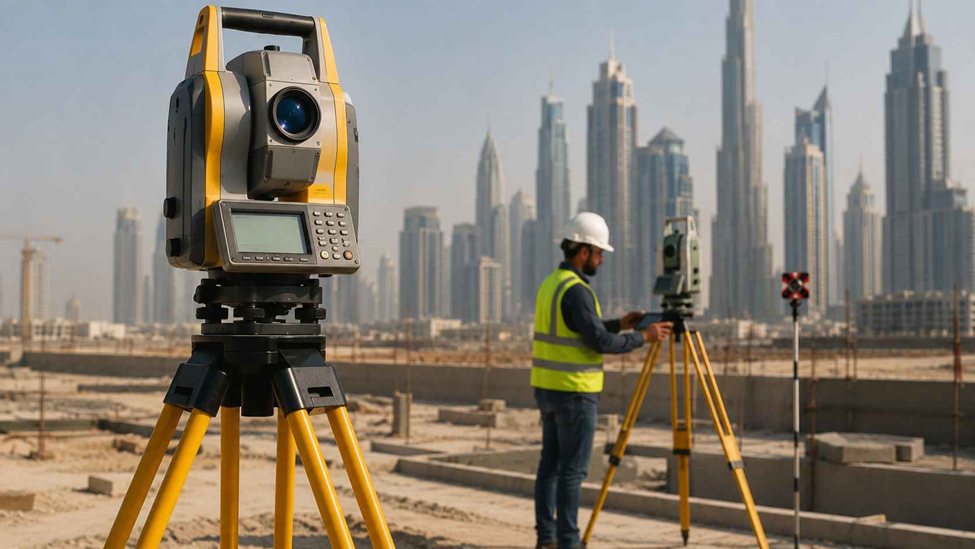
The price of a Total Station machine in the UAE can range from a few thousand dirhams to more than AED 150,000. The difference comes down to the instrument’s accuracy, measurement capabilities, automation, brand and condition.
A basic manual Total Station may be sufficient for routine construction setting out, while a robotic model can help survey teams complete repeated measurements with less manual operation.
Before choosing a machine, it helps to understand what you are paying for, which features your project needs and what additional costs may be involved. This guide covers Total Station machine prices in the UAE, the main factors affecting cost and the checks to make before purchasing.
What Is a Total Station?
A Total Station is an electronic surveying instrument used to measure angles, distances and the positions of points on the ground. It combines an electronic theodolite with an Electronic Distance Measurement (EDM) system to calculate the coordinates of surveyed points.
Surveyors use a Total Station to collect site measurements and mark positions according to construction drawings. It is commonly used for land surveys, topographic surveys, foundation and column positioning, road alignment, plot measurements and as-built surveys.
The measurements collected can be processed into survey drawings, coordinate reports and other engineering documents. These details help surveyors and construction teams carry out their work with accuracy.
How Much Does a Total Station Machine Cost in the UAE?
The cost depends on the model and its technical specifications. A manual Total Station generally costs less than a robotic instrument with automatic prism tracking and advanced field functions.
Total Station Machine Price in UAE: Cost Comparison
The table below provides indicative budgeting ranges for different types of Total Station equipment.
| Total Station Type | Estimated Price in UAE |
| Entry-level manual Total Station | AED 4,000–15,000 |
| Mid-range manual Total Station | AED 10,000–30,000 |
| Reflectorless Total Station | AED 12,000–40,000 |
| High-precision Total Station | AED 25,000–70,000+ |
| Robotic Total Station | AED 35,000–100,000+ |
| Premium robotic Total Station | AED 100,000–150,000+ |
| Used Total Station | AED 4,000–35,000+ |
Note: These are indicative price ranges, not fixed selling prices or quotations for specific models. Categories may overlap, and the actual cost depends on the manufacturer, specifications, equipment condition, accessories, warranty and supplier. Confirm current UAE pricing before purchasing.
An entry-level instrument may be enough for straightforward construction measurements, while high-precision or robotic equipment may be more suitable for demanding projects.
When comparing prices, check whether the quoted amount includes the tripod, prism, batteries, field controller, software and warranty. Two machines with similar specifications can have different total costs depending on what comes with the package.
What Factors Affect Total Station Machine Price?
Several factors influence the price of a Total Station. Understanding these differences helps you choose an instrument that suits your work without paying for features you may not need.
1. Measurement Accuracy
Total Station angular accuracy is commonly specified in arc-seconds, such as 1″, 2″, 3″ or 5″.
A lower arc-second value represents a finer angular specification. Instruments designed for high-precision applications generally cost more than basic models.
The right accuracy depends on the project requirements, including:
- Construction tolerances
- Required measurement distances
- Control network quality
- Surveying method
- Site conditions
A more expensive instrument is not automatically the best choice. The specification must match the work being carried out.
2. Manual or Robotic Operation
Manual and robotic Total Stations differ in how they are operated.
A manual Total Station requires the surveyor to aim and measure the target. Depending on the task, a second person may be needed to hold the prism.
A robotic Total Station can automatically track a prism and may support one-person surveying workflows.
Robotic instruments can be useful for:
- Large construction sites
- Repeated setting-out operations
- Detailed measurements across extensive areas
- Projects involving frequent point collection
- Work where reducing manual operation improves productivity
The additional investment may be worthwhile when the equipment saves enough field time across multiple projects.
3. Reflectorless Measurement
Reflectorless Total Stations measure distances to suitable surfaces without requiring a prism at the target.
This feature is useful when the surveyor cannot safely or easily place a prism at the required point.
Typical applications include building facades, inaccessible structural details and certain indoor measurements.
The available range and accuracy depend on the model, surface material, target angle and site conditions. Check the instrument specifications before paying extra for this feature.
4. Brand and Model
Leica, Trimble, Topcon and Sokkia are among the brands used in professional surveying. Other manufacturers offer instruments at different price points.
The cost depends on more than the brand name. Compare the following before making a decision:
- Angular accuracy
- EDM performance
- Reflectorless capability
- Robotic functions
- Field software
- Controller compatibility
- Warranty and service support
- Availability of spare parts
A model that works with your existing surveying equipment and software may offer better overall value than one that requires changes to your current workflow.
5. Software and Data Compatibility
A Total Station is only one part of the surveying process. The collected measurements must also be transferred, checked and processed.
Before purchasing, confirm that the instrument supports your team’s data collection and office processing requirements.
Check compatibility with:
- Coordinate and point-data formats
- Field coding systems
- CAD workflows
- DWG and DXF deliverables, where supported
- Data transfer methods
- Field controllers and software licences
These details can affect both the purchase cost and the time required to prepare survey deliverables.
6. Accessories and Equipment Package
The advertised price may cover the instrument alone or a complete field package.
Depending on the model and application, additional equipment may include:
- Tripod
- Prism and prism pole
- Batteries and charger
- Carrying case
- Field controller
- Data collection software
- Calibration or verification documentation
Ask the supplier for an itemised quotation. This makes it easier to compare the total cost of two different equipment packages.
New vs Used Total Station: Which Is Better?
A new instrument offers a different set of advantages from a used machine. The right choice depends on the available budget, expected workload and condition of the equipment.
Buying a New Total Station
A new Total Station may suit surveying companies and contractors that use the instrument regularly.
Potential advantages include:
- Manufacturer or supplier warranty, subject to the terms offered
- Access to current features
- Known equipment history
- Available technical support
- Options for training and maintenance
The purchase price is usually higher, so consider whether the additional features will be useful for your projects.
Buying a Used Total Station
A used Total Station may reduce the initial investment, especially for smaller companies or occasional surveying work.
Before purchasing a second-hand instrument, check:
- Calibration and service history
- Angle and distance measurement performance
- Compensator operation
- Display, keyboard and battery condition
- Prism tracking and reflectorless functions, if available
- Software and controller compatibility
- Spare-part availability
- Warranty and return conditions
Request recent calibration or verification records where available, and test the instrument before completing the purchase.
A machine with a low price can become expensive if it needs repairs or produces unreliable measurements.
Which Total Station Is Suitable for Your Project?
The right instrument depends on the measurements required and the conditions on site.
Total Station for Building Construction
Construction teams use Total Stations to position foundations, columns, walls and gridlines according to design coordinates.
For routine setting out, a suitable manual instrument may be sufficient. Projects with frequent measurements over large areas may benefit from robotic operation.
Total Station for Road and Infrastructure Surveys
Road and infrastructure projects may require alignment measurements, cross sections, control points and setting-out work.
The choice depends on the length of the survey corridor, visibility, required tolerances and the volume of measurements.
Total Station for Topographic Surveys
A Total Station can measure ground levels and existing site features where suitable lines of sight are available.
For larger open areas, GNSS equipment or drone mapping may also be suitable. Survey teams can combine these methods when the site conditions and project specifications require it.
Total Station for Structural and Industrial Work
Structural and industrial projects may require detailed measurements of columns, steelwork, equipment foundations and existing installations.
The instrument’s accuracy, measurement range and data workflow should match the project specifications. Appropriate control, instrument setup and independent checks remain essential.
Total Station vs GPS/GNSS: Which Should You Choose?
A Total Station measures angles and distances to determine point positions. GPS/GNSS equipment uses satellite signals to calculate positions within a suitable coordinate reference system.
A Total Station may be the better choice when:
- Working around buildings where satellite signals are obstructed
- Measuring detailed structural features
- Carrying out construction setting out
- Checking the relative positions of points
- Measuring locations with a suitable line of sight
GNSS may be more practical for:
- Surveying large open areas
- Establishing site coordinates
- Collecting points where satellite visibility is adequate
- Covering accessible road and infrastructure corridors
The two technologies can complement each other. The decision should be based on accuracy requirements, site conditions and the survey deliverables.
What Should You Check Before Buying a Total Station?
Use this checklist before confirming an order.
- Accuracy: Does the instrument meet the project’s required tolerances?
- Measurement range: Is the EDM range suitable for the expected working conditions?
- Operating mode: Do you need manual, reflectorless or robotic functionality?
- Software: Can the collected data be used in your current workflow?
- Accessories: Are the required field components included?
- Calibration: Are suitable verification or calibration records available?
- Warranty: What does the supplier cover?
- Service support: Can the instrument be repaired and maintained locally?
- Total cost: Have you included accessories, software, training and maintenance?
Comparing these points will help you evaluate the equipment on its suitability for the job rather than purchase price alone.
Need Total Station Surveying Support?
Northern Engineering Surveys L.L.C. (NES Dubai) provides surveying services for construction, engineering and infrastructure projects across Dubai and the UAE.
Our services include Total Station Survey, Topographic Survey, GPS Survey, Setting Out, Control Points, As-Built Survey, Plot Demarcation and 3D Laser Scanning.
If your project requires site measurements, construction setting out or survey data for engineering drawings, contact our team to discuss the scope and required deliverables.
Northern Engineering Surveys L.L.C.
Office No. 109, Mozna Building, near Al Nahda Metro Station, Al Qusais, Dubai, UAE.
Phone: +971 50 255 8005
Email: info@nesdubai.com
Website: https://nesdubai.com/
Frequently Asked Questions
1. What is the starting price of a Total Station in the UAE?
Some entry-level Total Stations are available from around AED 4,000, depending on the model and package. Higher-specification and robotic instruments can cost considerably more. Request a current quotation for the exact model.
2. Which Total Station brands are commonly used for surveying?
Leica, Trimble, Topcon and Sokkia are commonly used in professional surveying. Compare their specifications, software compatibility, warranty and service support before selecting a model.
3. Is a robotic Total Station better than a manual model?
A robotic Total Station can improve productivity on projects involving frequent measurements and setting-out work. A manual model may be sufficient for smaller projects or workflows that already use a two-person crew.
4. Is a used Total Station worth buying?
A used instrument can be a cost-effective option if its condition, measurement performance and service history have been checked. Confirm calibration records, spare-part availability and warranty terms before buying.
5. What accessories are required for a Total Station?
Depending on the model, the setup may require a tripod, prism, prism pole, batteries, charger, field controller and data collection software. Check the quotation to see which items are included.
6. Can a Total Station be used for construction setting out?
Yes. Surveyors use Total Stations to transfer design coordinates to the ground and position foundations, columns, gridlines and other construction elements. The work should follow the project’s control and accuracy requirements.