
Introduction
Before construction starts, the site may look ready from the surface. But what is underneath the ground can be very different from what is visible.
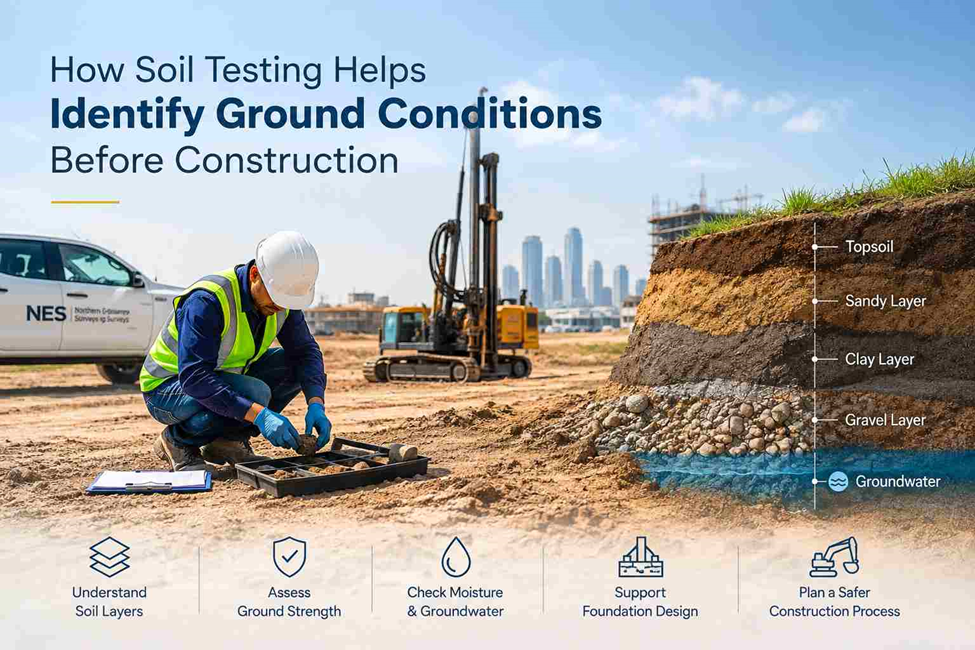
Soil testing gives the project team information about the ground below the proposed construction area. The results can help engineers understand how the soil behaves, identify changes between different parts of the site, and make decisions during the design and planning stage.
The important point is that soil testing is not only about collecting samples and getting laboratory results. The real value comes from using those results to understand what the construction team may encounter below the surface.
1. Soil Testing Helps Build a Picture of What Is Below the Site
A construction site can contain different soil conditions at different depths and locations.
A test from one area may show different material from another part of the same site. There may also be layers of natural soil, previously placed fill, weathered material, or other ground conditions.
Soil testing helps the project team build a clearer picture by providing information from selected locations and depths.
This information can then be considered together with the site investigation data to understand how the ground changes across the project area.
2. Different Soil Layers Can Behave Differently
The ground below a site is rarely one uniform material from the surface downward.
A typical investigation may encounter several layers with different characteristics. One layer may be relatively dense, while another may be softer or behave differently when loaded.
This matters because a building does not simply interact with the soil at ground level. The foundation transfers loads into the ground below it.
Soil test results help engineers understand these changes instead of assuming that the entire site has the same ground conditions.
3. Soil Strength Gives Engineers Useful Ground Information
One of the questions before construction is how the soil responds when a load is placed on it.
Testing can provide information about soil strength and other engineering properties that are considered during foundation and structural design.
The results do not work as a simple “pass or fail” test for a construction site. Engineers look at the test results together with the proposed structure, foundation arrangement, ground profile and other project information.
This gives them a more realistic basis for making design decisions.
4. Soil Testing Can Show Where Ground Conditions Change
This is particularly important on larger construction sites.
For example, testing locations across a site may produce different results. That difference can indicate that the ground is not consistent throughout the development area.
The project team can then pay closer attention to those areas during design and planning.
Instead of treating the entire plot as one identical block of soil, engineers can work with information from different locations and depths.
5. Testing Helps Identify Ground Conditions That May Affect Construction
Soil testing can provide information about conditions that need to be considered before excavation and foundation work begins.
Depending on the site, the investigation may identify issues such as:
- Weak or compressible soil, which may require further engineering assessment before construction.
- Uncontrolled or variable fill, where the material and placement history may not be consistent.
- High moisture conditions, which can influence soil behavior and construction activities.
- Groundwater, which may become important during excavation or below-ground construction.
- Different soil layers, where each layer may respond differently to loading.
The purpose is not to assume that every site has these problems. It is to identify what conditions actually exist so they can be considered during project planning.
6. Soil Testing Supports Foundation Planning
Foundation design depends on several factors, including the structure being built and the conditions below it.
Soil testing provides part of the ground information engineers need when assessing foundation requirements.
For example, the results can help engineers understand:
- How the ground may respond to structural loads
- Whether different soil layers need to be considered
- Whether settlement needs particular attention
- Whether groundwater conditions could affect below-ground work
- Whether additional investigation may be required
The final foundation design remains an engineering decision based on the complete set of project information.
7. Soil Conditions Can Affect Excavation Work
Soil information is useful before the excavator reaches the site.
Different ground materials can behave differently during excavation. Groundwater can also become an important consideration for deeper excavation.
Knowing the expected ground conditions gives the construction team information that can be considered when planning excavation activities, temporary works and site operations.
This is one reason why investigating the ground before breaking ground is more useful than discovering unexpected conditions after construction has already started.
8. Soil Testing Is Also Important for Roads and Pavements
Soil testing is not limited to building foundations.
For roads, parking areas and other paved surfaces, the condition of the underlying ground can affect the design and construction approach.
Testing can provide information about the soil and subgrade conditions that engineers consider when developing the pavement design.
For a road project, this means the investigation needs to look beyond the finished surface and understand the ground supporting it.
9. Test Results Need to Be Read Together
A single laboratory result does not tell the complete story of a construction site.
The useful picture comes from looking at:
Site investigation + field observations + samples + laboratory results + groundwater information + project requirements
When these pieces are considered together, engineers can develop a better understanding of the ground conditions.
This is also why soil testing should not be treated as an isolated laboratory activity.
10. What Happens After the Soil Testing?
Once field and laboratory testing is completed, the results are compiled and reviewed as part of the ground investigation process.
The information can then be used by the project team during:
- Foundation design
- Excavation planning
- Ground improvement assessment
- Road and pavement design
- Site development planning
- Construction planning
The important step is turning the test results into information that can actually be used for the project.
FAQ ideas
These are worth adding at the end without duplicating the existing NES Soil Investigation FAQ too closely:
1. Can soil conditions change across the same construction site?
Yes. Different areas and depths can contain different soil materials and ground conditions, which is why investigation locations need to represent the project area.
2. Why should soil testing be done before construction?
It provides information about the ground before foundation, excavation and other major construction activities begin.
3. Can soil testing help with road construction?
Yes. Soil and subgrade information can be considered during pavement and road design.
4. Does soil testing alone determine the foundation design?
No. Foundation design considers soil information together with structural loads, site conditions, design requirements and other engineering factors.
5. What is the difference between soil testing and soil investigation?
Soil testing focuses on obtaining specific information about soil properties, while soil investigation is the broader process of studying subsurface conditions using field investigation, sampling and testing.