
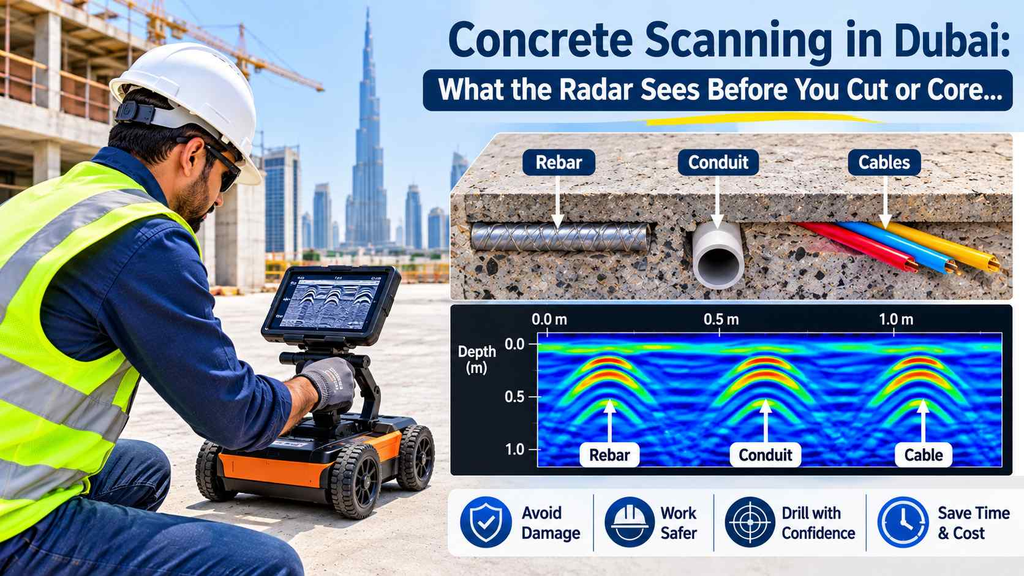
A concrete slab looks plain from the top. Inside, it can hold steel bars, power cables, water pipes and post-tension tendons. One wrong cut can hit any of them. That is why concrete scanning in Dubai is now a standard step before cutting, coring or drilling. This blog explains what the radar shows, when you need a scan, and what to avoid.
1. Why Scanning Comes Before Every Cut
Drawings are not always right. Sites change, and builders sometimes move things on the day. A scan shows what is actually inside the slab today.
- Stops damage to cables, conduits and pipes
- Protects workers from electric shock and burst lines
- Avoids cutting through rebar and weakening the structure
- Saves money on repairs, delays and rework
A scan takes far less time than fixing a cut cable.
2. What the Radar Detects Inside Concrete
Most scans use ground penetrating radar (GPR). The same technology is used in a utility survey to find buried services. The scanner sends a radar signal into the concrete and reads the echoes that bounce back. Different materials give different echoes.
- Rebar and mesh: spacing and rough depth
- Post-tension cables: these are under high tension and dangerous to cut
- Electrical conduits: live or dead, you still need to avoid them
- Water and drainage pipes: especially in wet areas
- Voids and thickness changes: gaps or uneven slab depth
Note that radar shows where something is. It does not always tell you what it is. A trained operator reads the screen and makes the call.
3. When You Need Concrete Scanning in Dubai
Dubai has many tall towers, podium slabs and busy renovation projects. Scan before any of these jobs:
- Core cutting for pipes, ducts or sleeves
- Saw cutting for openings, doors or stair cuts
- Drilling anchors or fixings into a slab
- Renovation or fit-out work in an older building
- Demolition planning
- Adding new services through floors or walls
If the work touches a slab, wall or beam, scan first. It matters even more in basements and parking decks, where slabs are thick and crowded.
4. How the Scanning Process Works
The process is short and simple.
- Plan the area : You and the surveyor agree on where the cut or core will go.
- Prepare the surface :The surface should be clean and clear of loose items.
- Scan in a grid : The operator runs the scanner across the area in both directions.
- Read the data : The screen shows signals. The operator marks what they find.
- Mark the slab : Safe zones and no-go zones are painted or taped on the surface.
- Report : Findings are shared as marks on site, with notes or drawings if needed.
Good teams also check the results against the building plans. Data from a scan can feed into an as-built survey or a BIM model when a full record is needed.
5. Mistakes to Avoid Before Cutting or Coring
Most scan problems come from rushed planning.
- Trusting old drawings only :Changes made on site are rarely recorded.
- Scanning a small patch : Scan a wider area than the cut so you have room to shift.
- Skipping the scan on thin slabs :Thin slabs have less room for error.
- Not telling the scanner about the job :The operator needs to know what you are cutting.
- Ignoring the marks : If the crew paints over or moves marks, the scan is wasted.
- Scanning only from one side : Some slabs need a check from above and below.
6. How to Choose a Scanning Company
Ask a few direct questions before you hire.
- Do they use modern GPR equipment, and can the operator explain the results?
- Do they mark the slab on site, not just send a report later?
- Can they work with other survey data, such as 3D laser scanning?
- Do they explain the survey methodology and equipment clearly?
- Can they respond fast when your site schedule is tight?
You can also read our earlier guide on ground survey equipment to see how survey tools differ. For a quote or site visit, reach the team on the contact page.
Conclusion
A scan is a small step with a big payoff. It shows rebar, cables and pipes before the blade or drill bit does. In a city as busy as Dubai, that protects your crew, your schedule and your budget. Scan first, mark clearly, then cut.
FAQ :
What is concrete scanning?
It is a non-destructive check that finds rebar, cables, pipes and voids inside concrete.
Does scanning damage the slab?
No. The scanner sits on the surface and nothing is drilled or broken.
How deep can radar see in concrete?
It depends on the equipment and slab. Most jobs cover the top few hundred millimetres.
Can radar find every pipe or cable?
Not always. Very deep or tightly packed items can be hard to read, so the operator’s skill matters.
When should I scan?
Before any cutting, coring or drilling, and ideally before the contractor mobilises.