
Concrete Scanning: GPR Machine, Slab Detection and Cost Guide
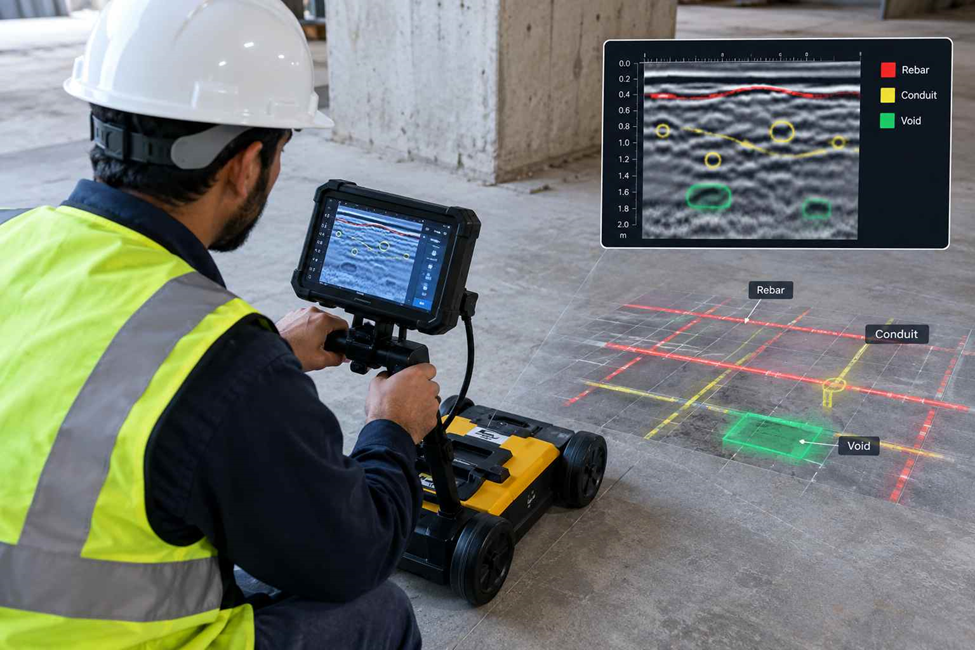
Before drilling, cutting or coring concrete, contractors need to identify hidden reinforcement bars, electrical conduits and post-tensioning cables. Concrete scanning using Ground Penetrating Radar (GPR) helps locate these concealed features without damaging the surface.
For consultants, contractors, developers and MEP teams, concrete scanning supports safer drilling, better service coordination and informed construction planning.
This guide covers concrete scanning machines, GPR detection capabilities, scanning depth, cost factors and common concrete testing methods.
What Is Concrete Scanning?
Concrete scanning is a non-destructive inspection method used to locate hidden objects inside or beneath concrete. Ground Penetrating Radar (GPR) sends electromagnetic signals into the concrete, helping technicians identify the likely positions and depths of embedded features.
Concrete scanning is commonly used before core drilling, anchor installation, slab cutting, building renovations and MEP service installations.
Unlike destructive methods, GPR scanning examines concrete from the surface without requiring exploratory holes, making it useful when existing drawings are incomplete or embedded services need to be located.
How Does a Concrete Scanning Machine Work?
A concrete scanning machine equipped with GPR technology uses a radar antenna and data processing system to examine the internal structure of concrete.
The operator moves the scanner across the selected area along planned scan lines. When the radar signal encounters a material interface, some of the energy returns to the antenna. The equipment records these responses and displays them as radar profiles or processed images.
The technician then interprets the data to identify potential reinforcement, cables, conduits and other detectable features.
A typical concrete scanning procedure involves four steps:
- Site assessment: Review the proposed drilling or cutting locations, available drawings and site conditions.
- GPR scanning: Move the scanner across the selected area using suitable scan lines or a grid pattern.
- Data interpretation: Assess the radar responses to determine the likely positions and depths of embedded features.
- Marking and reporting: Mark relevant locations on the concrete surface and provide findings according to the agreed scope.
The accuracy of the results depends on the equipment, concrete conditions, target characteristics and operator experience. GPR does not automatically identify every object or guarantee that all concealed features will be detected.
What Does Concrete Slab Scanning Detect?
Concrete slab scanning helps identify features that may affect drilling, cutting, anchoring or other construction activities. The results depend on the size, depth, orientation and material properties of the target.
Reinforcement Bars (Rebar)
Reinforcement bars are embedded in concrete to provide structural strength. GPR scanning can help identify their positions, spacing and approximate cover depth. This information is useful before drilling anchor holes or creating openings in reinforced concrete.
Post-Tensioning Cables
Post-tensioned slabs contain stressed cables that contribute to the structural performance of the building. Damaging a tendon can create serious safety and structural risks. Concrete scanning helps locate potential cable paths before intrusive work is considered.
Electrical Conduits and Embedded Services
Electrical conduits, service routes and other embedded components may cross the proposed drilling location. Metallic conduits generally produce detectable radar responses, while plastic conduits may be more difficult to identify depending on their size, depth and surrounding conditions.
Potential Voids Beneath Concrete
GPR can sometimes identify reflections associated with voids or changes in material beneath a slab. Additional investigation may be needed to confirm whether a suspected feature is a void and determine its extent.
Slab Thickness and Embedded Feature Depth
Under suitable conditions, radar data can help estimate concrete thickness and the depth of embedded features. The reliability of these estimates depends on signal quality, calibration and the properties of the concrete.
GPR results should be interpreted carefully. A radar response does not always reveal the exact material, size or condition of an object.
How Deep Can GPR Scan Concrete?
The effective depth of GPR concrete scanning varies according to the antenna frequency, concrete composition, moisture content, reinforcement density and size of the target.
For many construction applications, the main objective is to locate reinforcement, conduits and cables within a concrete slab rather than investigate deeply beneath the structure.
Higher-frequency antennas generally provide better resolution for shallow targets, while lower-frequency systems may offer greater penetration with less detail. Dense reinforcement can also block or obscure signals from deeper objects.
Several factors influence the practical scanning depth:
- Antenna frequency: Different frequencies offer different combinations of penetration and resolution.
- Concrete condition: Moisture and material composition affect radar signal transmission.
- Reinforcement density: Closely spaced steel can make deeper features difficult to distinguish.
- Target size and material: Small or weakly contrasting objects may produce limited responses.
- Data interpretation: Accurate depth estimation depends on suitable calibration and signal analysis.
There is no single scanning depth that applies to every concrete scanning machine. The appropriate equipment and expected detection range should be assessed for the specific structure and inspection requirement.
How Much Does Concrete Scanning Cost in Dubai?
Concrete scanning costs in Dubai and across the UAE vary depending on the scanning area, number of locations and reporting requirements. Published UAE service-provider estimates range from approximately AED 500 to AED 3,000 or more per area, depending on the project scope.
| Concrete Scanning Scope | Indicative Cost (AED) |
| Small-area concrete scanning | 500–1,200 |
| Standard GPR concrete scanning | 1,200–2,500 |
| Detailed slab scanning and mapping | 2,500–4,500 |
| Complex or post-tension cable scanning | 3,000–6,000 |
Note: These are indicative market estimates, not fixed rates or a quotation from Northern Engineering Surveys L.L.C. Actual prices depend on site conditions, scan coverage and deliverables.
What Are the Different Types of Concrete Testing?
Concrete testing includes several methods used to assess material properties, structural condition and internal features. GPR concrete scanning is mainly used to locate concealed objects and should not be confused with tests that assess concrete strength.
1. Ground Penetrating Radar (GPR)
GPR scanning is used to locate detectable reinforcement, embedded services and other subsurface features. It may also help estimate slab thickness under suitable conditions.
2. Rebound Hammer Test
A rebound hammer measures the rebound of a spring-loaded mass against the concrete surface. The result provides an indication of surface hardness but does not independently establish the actual compressive strength of the concrete.
3. Ultrasonic Pulse Velocity (UPV) Test
UPV testing measures the time taken for an ultrasonic pulse to travel through concrete. It can help assess uniformity and identify areas that may require further investigation.
4. Concrete Core Testing
Core testing involves extracting a physical sample from the concrete for laboratory examination. It can provide a direct measurement of compressive strength under the applicable testing procedure, but the sampling location must be selected carefully.
5. Half-Cell Potential Testing
This electrochemical method helps assess the likelihood of corrosion activity in reinforcing steel under suitable conditions. It does not directly measure the corrosion rate.
6. Cover Meter Testing
A cover meter is used to locate reinforcement and estimate the concrete cover over the steel. Its capabilities differ from GPR, particularly when assessing deeper targets or complex reinforcement arrangements.
The appropriate testing method depends on the project requirements. If the objective is to locate embedded services before drilling, GPR may be suitable. If the objective is to assess concrete strength, a qualified engineer may recommend core testing or other appropriate methods.
Concrete Scanning Machine vs Other Inspection Equipment
Different inspection instruments are designed to answer different technical questions. Choosing the correct equipment depends on the information required.
GPR concrete scanner: Used to locate detectable embedded features and investigate certain subsurface conditions.
Cover meter: Used primarily to locate reinforcement and estimate concrete cover.
Ultrasonic testing equipment: Used to assess concrete properties through sound-wave transmission.
Rebound hammer: Used to assess relative surface hardness.
Concrete coring equipment: Used to extract samples for direct material testing.
A concrete scanning machine is particularly useful when contractors need information about concealed features before drilling, coring or cutting. However, it cannot replace every concrete testing method or independently confirm the structural safety of a proposed opening.
Why Is Concrete Scanning Important Before Drilling?
Drilling into concrete without checking for embedded components can damage reinforcement, electrical conduits, post-tensioning cables or other services. Such damage may lead to repairs, project delays, safety concerns and additional costs.
Concrete scanning helps construction teams make better-informed decisions before intrusive work begins.
The main benefits include:
- Reduced risk of damage: Helps identify potential obstructions at proposed drilling locations.
- Improved site coordination: Provides information that contractors and consultants can use when reviewing penetrations.
- Less avoidable rework: Helps reduce the likelihood of damaging concealed components.
- Non-destructive inspection: Allows concrete to be examined from the accessible surface.
- Better documentation: Scan findings can be recorded for project coordination and reference.
Scanning is an important inspection step, but it does not replace structural approval, permit requirements or the project’s approved method of work. Scan findings should be reviewed alongside the relevant drawings and safety procedures before drilling or cutting is authorised.
Concrete Scanning Services in Dubai by Northern Engineering Surveys L.L.C.
Northern Engineering Surveys L.L.C. provides surveying and scanning-related services for construction and engineering projects. Concrete scanning using GPR is referenced on the company’s existing 3D Laser Scanning Services page.
For projects involving drilling, coring, cutting or new service installations, the scanning requirements should be established according to the proposed work, available drawings and site conditions.
Consultants, developers, main contractors and subcontractors should identify the proposed penetration locations and provide relevant structural information before requesting a quotation. This helps establish the required inspection coverage and reporting scope.
For surveying and project-related enquiries, contact Northern Engineering Surveys L.L.C.
Website: https://nesdubai.com/
Email: info@nesdubai.com
Phone: +971 50 255 8005
Frequently Asked Questions
What is concrete scanning used for?
Concrete scanning is used to locate detectable reinforcement, post-tensioning cables, conduits and other concealed features before drilling, coring or cutting concrete.
What does a GPR concrete scanning machine detect?
A GPR scanner can identify and help map reinforcing bars, post-tensioning cables, metallic conduits and some non-metallic services. It may also identify certain voids or changes in material, depending on the conditions.
How deep can GPR scan concrete?
The effective depth depends on antenna frequency, concrete composition, moisture, reinforcement density and target characteristics. The usable depth must be assessed for the specific structure and equipment.
How much does concrete scanning cost in Dubai?
The cost depends on the area, number of scan locations, site access, required detail and reporting scope. A project-specific quotation is needed to establish the price.
Is concrete scanning necessary before core drilling?
Scanning is an important precaution before core drilling because it helps identify potential obstructions at the proposed location. The results should be reviewed alongside structural drawings and site safety requirements.
Can GPR concrete scanning measure concrete strength?
No. GPR is mainly used to investigate concealed features and material interfaces. Concrete strength assessment requires suitable testing methods, such as core testing, where specified.
Can a concrete scanning machine detect plastic pipes?
Some plastic pipes and conduits can be detected, but detection is not guaranteed. Results depend on the pipe size, depth, contents, surrounding material and scanning equipment.
What is the difference between concrete scanning and concrete testing?
Concrete scanning primarily locates concealed features inside or beneath concrete. Concrete testing covers methods used to assess properties such as compressive strength, surface hardness, uniformity and corrosion-related indicators.